This document serves as a comprehensive manual for the Aviator online game, a crash-style gambling title that has gained significant traction. Unlike traditional slots or table games, Aviator’s core mechanic revolves around a multiplier that increases from 1.00x until it randomly « crashes. » This guide deconstructs its operation, optimal betting frameworks, and the underlying technology, providing a foundation for informed play.
Before engaging with real funds, it is imperative to understand the game’s non-linear risk profile and inherent house edge. This whitepaper covers registration, game theory, bankroll management, and advanced troubleshooting.
Before You Start: Prerequisite Checklist
Engaging with Aviator requires preparation. Ensure you meet these criteria:
- Jurisdictional Compliance: Verify that online gambling and crash games are legal in your region. Access may be geo-blocked.
- Age Verification: You must be of legal gambling age (typically 18+ or 21+, depending on jurisdiction).
- Licensed Platform: Only play on casinos licensed by reputable authorities (MGA, UKGC, Curacao eGaming) that host legitimate versions of the game.
- Financial Preparedness: Allocate a dedicated bankroll you can afford to lose. Never gamble with funds earmarked for essentials.
- Technical Setup: Use a stable internet connection. Consider a bookmark to the direct game page for faster loading.
- Demo Proficiency: Commit to mastering the game via the aviator demo mode before any real-money play. This is non-negotiable for strategy testing.
Account Registration & Game Access Protocol
Accessing Aviator requires an account on a hosting casino platform. The process is standard:
- Platform Selection: Choose a licensed casino offering the official Aviator game (often by Spribe).
- Registration: Click ‘Sign Up’ and complete the form with accurate personal details (name, DOB, address). Discrepancies will complicate future withdrawals.
- Verification: Submit required KYC documents (ID, proof of address) as prompted. Proactive verification speeds up later processes.
- Deposit: Navigate to the cashier, select a payment method (e.g., card, e-wallet, crypto), and fund your account. Note any transaction fees.
- Game Location: In the casino lobby, search for « Aviator » or navigate to the ‘Crash Games’ or ‘Live Games’ section. Load the game.
- Demo Switch: Before betting, locate and select the ‘aviator demo‘ or ‘Play for Fun’ mode to acclimate.
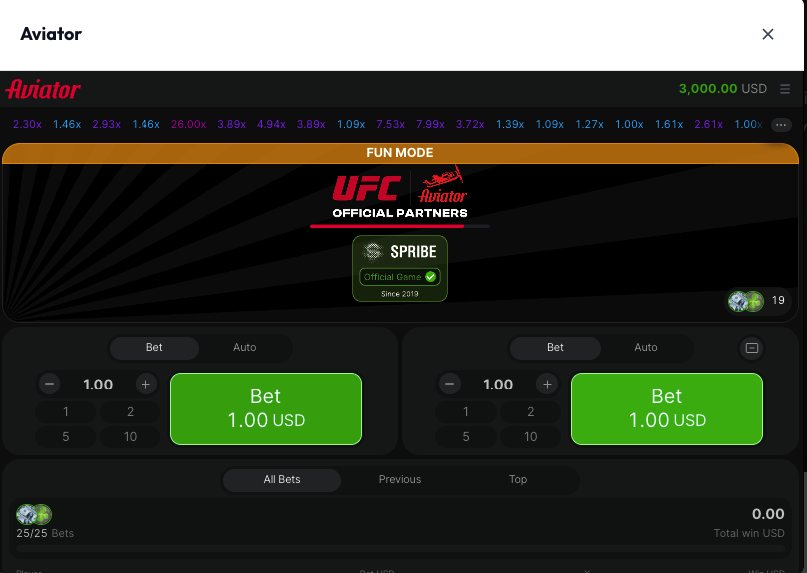
Game Mechanics & Core Algorithmic Principles
Aviator presents a singular, transparent mechanic. Players place a bet before a round starts. A line graph (the « aircraft ») then charts a multiplier climbing from 1.00x. You must manually cash out before the multiplier crashes at a random, algorithmically determined point. If you cash out successfully, your payout is (Bet Amount * Multiplier at Cash-Out). If the crash occurs before you cash out, you lose the bet.
The Random Number Generator (RNG): The crash point for each round is determined by a Provably Fair RNG system. A typical formula is: Multiplier = (100 / (X %)) * 0.95, where X is a cryptographically secure random number between 0 and 99. The 0.95 multiplier represents a ~5% house edge. Reputable providers like Spribe allow players to verify each round’s fairness using a seed number.
Strategic Framework & Mathematical Modeling
Strategy in Aviator is about risk management, not prediction. The following table outlines common approaches:
| Strategy Name | Core Principle | Mathematical Operation | Risk Profile | Bankroll Impact |
|---|---|---|---|---|
| 1.5x Cash-Out | Conservative, volume-based. | Target multiplier: 1.5x. Payout = Bet * 1.5. Win probability per round is high, but profits are small. | Very Low | Low volatility, slow grind. |
| Martingale (Cautious) | Double bet after a loss, reset after a win. | Bet sequence: 1, 2, 4, 8, 16… After N losses, bet = 2^N. Goal: recoup losses +1x initial bet on next win. | Very High | Requires large bankroll; table limits will break it. |
| D’Alembert | Increase bet by 1 unit after loss, decrease by 1 after win. | Unit = 1% of bankroll. Bet sequence: 1, 2, 3, 2, 1… More forgiving than Martingale. | Moderate | Moderate volatility. |
| Compound Interest (2x+) | Let profits ride over multiple successful rounds. | Start with base bet. On win, re-bet original stake + profit. E.g., $10 at 2x = $20 profit. Next bet: $30 total. | High | High volatility; can generate large wins from small stakes. |
Mathematical Expectation Calculation: Assume a house edge of 5%. If you consistently cash out at a target multiplier of 2.0x, your theoretical Return to Player (RTP) is 95%. For a $10 bet: Expected Value (EV) = (Probability of Win * Profit) – (Probability of Loss * Bet). With a simplistic model where a crash before 2x is a loss: EV = (0.475 * $10) – (0.525 * $10) = -$0.50. This negative EV is constant across all strategies; they only manage the distribution of outcomes.
Demo Practice Imperative: The aviator demo mode is the laboratory for these strategies. Test each for at least 100-200 rounds to observe frequency of ruin versus profit peaks without financial risk.
Financial Operations: Deposits & Withdrawals
The funding lifecycle is managed by the host casino, not the game itself.
- Deposits: Instant via most methods (cards, e-wallets, online banking, crypto). Minimum deposits often range from $10-$20.
- Withdrawals: Processed by the casino. Speed varies: e-wallets (0-24h), cards/ bank transfer (1-5 business days). Withdrawals require completed KYC verification.
- Important: Bonus funds often come with wagering requirements (e.g., 35x). Crash games may contribute 5-10% to these requirements, making them inefficient for clearing bonuses.
Security, Fairness, & Troubleshooting
Security: Ensure the casino uses SSL encryption (look for ‘https://’ and a padlock icon). Your gaming activity should be protected.
Fairness: The game’s Provably Fair system is critical. Reputable versions provide a « Fairness » or « Info » tab where you can verify the hash and seed for previous rounds to confirm the crash point was predetermined and not manipulated.
Troubleshooting Common Issues:
- Game Won’t Load: Clear browser cache and cookies. Disable ad-blockers/extensions. Try a different browser (Chrome, Firefox). Ensure JavaScript is enabled.
- Cash-Out Button Unresponsive/Lag: This is catastrophic. Cause: local device lag or internet latency. Solution: Use a wired connection if possible, close all other bandwidth-intensive applications, upgrade hardware, or use a casino’s dedicated app if available. Consider a lower, pre-set auto cash-out to mitigate this risk.
- Unable to Access Demo Mode: Sometimes only available while logged out. Try accessing the game directly via the provider’s (Spribe) website or a different casino’s free-play lobby.
- Withdrawal Delayed: First, ensure KYC is complete. Contact casino support with your transaction ID. Delays can be due to internal security checks or payment processor bottlenecks.
- Suspected Unfair Play: Use the in-game Provably Fair tool to verify recent rounds. If inconsistencies persist, report to the casino and the licensing authority, providing round IDs and evidence.
Extended Technical FAQ
- Q: Is the Aviator online game truly random, or can it be predicted?
A: It is cryptographically random. The crash point is generated by a Provably Fair RNG at the round’s start and cannot be predicted. Patterns in past rounds have no bearing on future ones. - Q: What is the actual house edge in Aviator?
A: The standard theoretical edge is approximately 5%. This is achieved through the formula (e.g., Multiplier = (100 / (X %)) * 0.95). The exact value can be verified in the game’s information panel. - Q: Is there an optimal auto cash-out setting?
A> There is no mathematically « optimal » setting, as expectancy is negative. Auto cash-out is a risk-management tool. A lower setting (e.g., 1.2x) yields high win frequency but small profits. A higher setting (e.g., 3x) yields lower frequency but larger wins. The choice is a function of your risk tolerance. - Q: Can I play the aviator demo indefinitely without an account?
A: Yes, on most platforms that offer it. The demo uses virtual credits that refresh, providing an unlimited sandbox for testing. - Q: How does the « Bet Behind » or « Copy Bet » feature work?
A: This allows you to piggyback on another player’s bet in real-time, mirroring their stake and cash-out action. Your risk and reward are proportional to your own bet size. It’s useful for following perceived strategic players, but their decisions are not guaranteed to be optimal. - Q: Are there statistical biases in the crash point distribution?
A> In a correctly implemented RNG, the distribution of crash points should follow a predictable curve where lower multipliers (e.g., 1.00x-2.00x) occur far more frequently than extremely high ones (e.g., 100x+). This is a feature of the algorithm, not a bias. - Q: My balance didn’t update after a cash-out. What happened?
A: First, refresh the game. If the issue persists, check your casino transaction history. There may have been a communication error between the game client and the casino server. Contact support with the round ID (visible in game history). - Q: Does using multiple bets in one round (e.g., two separate bet boxes) affect the RNG?
A: No. The crash multiplier is singular per round. Placing multiple bets is simply allocating your stake across different cash-out strategies within the same random event. - Q: Is data from my demo play valuable for real-money strategy?
A> Yes, for understanding mechanics and interface timing. No, for statistical forecasting. The RNG in demo and real-money modes should be identical, so timing and strategy reflexes are transferable, but past results remain non-predictive. - Q: What is the single largest risk factor for players of Aviator?
A> Psychological chasing behavior. The fast-paced, high-action nature can lead to impulsive doubling-down after losses. Combined with the technical risk of cash-out lag, this creates a high-risk environment. Strict pre-session loss limits and time limits are essential safeguards.
Conclusion & Final Advisory
The aviator game presents a unique, transparent, but mathematically edged gambling format. Mastery lies not in prediction but in disciplined bankroll management, strategic use of auto cash-out, and a deep understanding of its Provably Fair system. The aviator demo mode is the cornerstone of safe learning. Ultimately, treat it as paid entertainment with a known cost (the house edge), never as a revenue source. Always prioritize play on licensed platforms, verify game fairness routinely, and implement strict personal limits to mitigate its inherently volatile nature.